
Smart Practice Guide
Consistent and focused practice is essential for musical growth and enjoyment. Students who develop good practice habits from the beginning often progress more confidently and effectively.
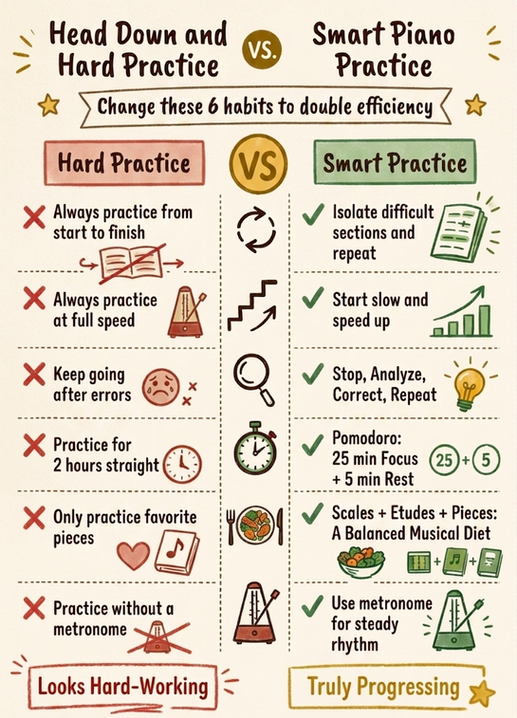
"Hard Practice" vs. "Smart Practice"
Instead of mindlessly playing a song from start to finish, Smart Practice isolates difficult sections to master them individually.
Rushing at full speed leads to errors. Effective practice means starting slow and incrementally increasing the tempo as precision improves.
• Handling Mistakes
Rather than playing through errors (which reinforces bad muscle memory), you should stop immediately, analyze the mistake, correct it, and repeat the correct version.
• Time Management
Practicing for two hours straight causes mental fatigue. Using the Pomodoro Technique (25 minutes of focus followed by a 5-minute break) keeps the mind sharp.
• A Balanced Musical Diet
Don't just play your favorite pieces. A well-rounded musician balances their routine with Scales, Etudes, and Pieces.
• Rhythm Stability
Playing without a structure leads to uneven timing. Always use a metronome to establish and maintain a steady rhythm.
Recommended Daily Piano Practice Time
The amount of practice time will vary depending on the student’s age, level, and learning goals. Consistency and quality of practice are crucial, and it's important to balance practice with breaks to avoid burnout.
Beginners (Ages 5–7): 15–20 minutes per day
Elementary (Levels 1–3): 20–30 minutes per day
Intermediate (Levels 4–6): 30–45 minutes per day
Early Advanced (Levels 7–8): 45–60 minutes per day
Advanced (Level 9 and above): 60–90+ minutes per day